PERSONS
THE INTERVIEW 嶋崎 雄斗/Yuto Shimazaki feat. 佐々木 健雄

When you search for "percussion instruments" on YouTube, the first video channel that comes up is "Yuto Shimazaki"!
Yuto Shimazaki, who is the operator of a channel that boasts approximately 221,000 subscribers, over 750 published videos, and over 100 million total views (as of March 5, 2024) and is also a pioneer percussion YouTuber, and Takeo Sasaki, who is in charge of video editing, participated remotely, and we talked about everything from the origins of video distribution to the behind-the-scenes stories of filming.
Interview: Japan Percussion Center Toshiyuki Yamada & Kenji Nishio
*This article has been revised from the one published in "JPC No. 172" published on April 10, 2022.
I think he was active on YouTube quite early among percussionists.
So, how did you get started streaming videos?
Shimazaki (hereinafter referred to as Shima):The video shoot itself started by filming the children's lessons.
I would like parents to observe their children's lessons as much as possible, but there are some who are unable to attend due to work commitments. So, I came up with the idea of shooting a video and having people watch it. I started using YouTube as a way to easily watch videos without having to use troublesome methods such as burning them to media such as DVDs.
The channel was not operated in an open manner from the beginning.
Shima:That's right. The video was only intended for parents to watch, and each family was notified of the URL of the video, which had been uploaded to the public for a limited time.
After that, since I had a channel, I began to publish the recorded concerts without editing, and I also thought it would be better to have reference videos of the works I composed and arranged, so I also made unedited videos of the songs I had composed and arranged.
I was doing it out of a perverse feeling that it would be great if it would lead to sales of sheet music (lol).
So, after that, I started using YouTube in earnest in the way I am now.Why?
Shima:Since my account was old to begin with, the number of subscribers to my channel gradually increased over the years, and before I knew it, I had over 1,000 subscribers.
When I was in such a situation, people who were knowledgeable about YouTube, including Mr. Sasaki, who has now become my partner, encouraged me by telling me, ``You can monetize this,'' ``Maybe you should take it more seriously,'' and ``Mr. Shimazaki, you're perfect for this!''
That was about four years ago.
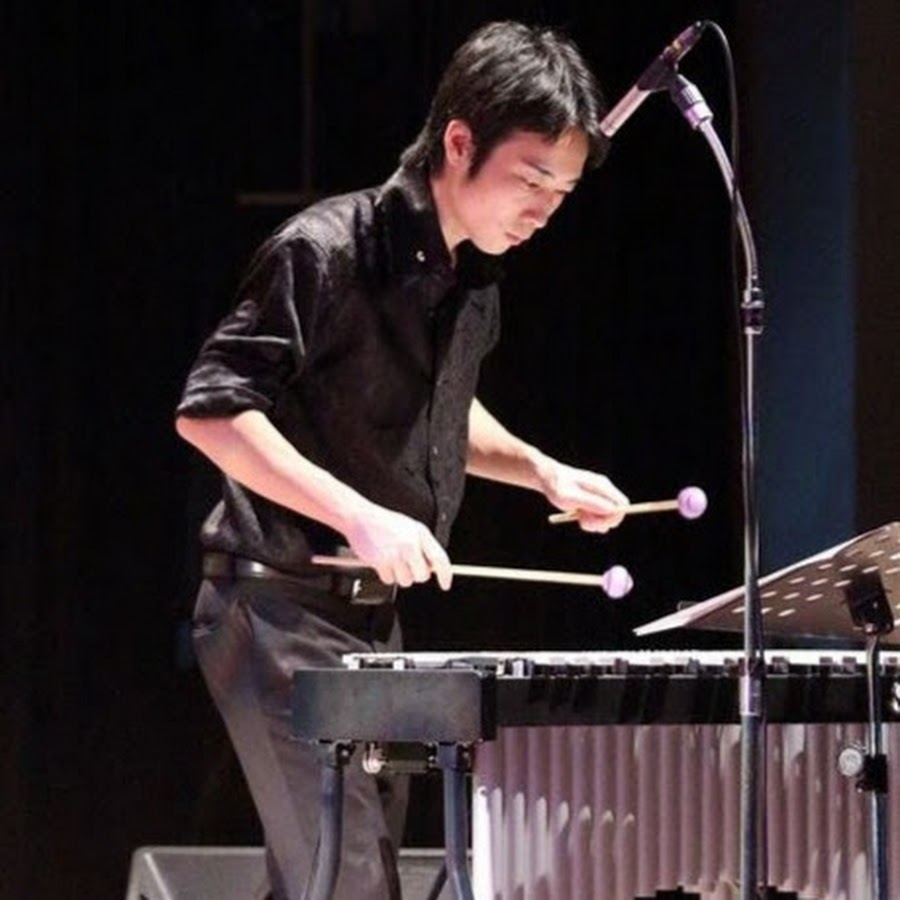
How did the two of you connect in the first place, and how did you start working as a team?
Sasaki (hereinafter referred to as Sa):It's a long story to talk about (lol)
Shima:Mr. Sasaki is the son of my teacher, Mr. Kunio Sasaki, who is extremely famous in the world of piano and solfege.
So, the first time we met was when Mr. Sasaki was in middle school and I was in high school, and we were attending a solfege class to prepare for music college entrance exams.
The teacher there was Sasaki-san's father.
Even if they knew about each other's existence, they had hardly ever talked to each other, and since they were both boys in the prime of adolescence, there was no way anything would happen if they passed each other (lol).
So, after I started working as a professional, I started being invited to my father's work as a guest, and I reunited with Mr. Sasaki, who was helping out there!
So, Mr. Sasaki was not particularly involved in percussion instruments.
Sa:That's right. I don't even play the piano, and I joined my father's company from a completely different field...
Shima:Actually, Mr. Sasaki told me, ``If you want to do it seriously, I'll do some editing.'' Well then, please (lol)
Sa:And here we are (everyone laughs)
By the way, does Mr. Sasaki also edit videos of people other than Mr. Shimazaki?
Sa:That's right. It was through Mr. Shimazaki, or rather, someone who knew Mr. Shimazaki approached me. Currently, I have about 4 to 5 people doing this on a regular basis. I feel like if it weren't for Mr. Shimazaki, I wouldn't be where I am today.
Shima:Wahahahahahaha~! (Looking proud lol)
When I look at YouTube, I think it can be roughly divided into three types: those that simply show performances, those that introduce instruments and equipment, and funny videos that put planning first.Where do you get the ideas for the content you shoot?
All the meringue videos you recommended before we talked.I watched it in full, and it was really interesting.
Shima:Merengue has received high praise from people in the music industry and in the same industry. But it was physically tough! (lol)
Ever since I decided to start streaming videos seriously, I've decided to focus on YouTube when it comes to songs, and I try to avoid choosing songs based on my own tastes as much as possible.
There are a lot of Kirbys for that reason.
Shima:Well, when I first tried to upload a performance video, my wife said to me, ``If you like Kirby so much, why don't you play Kirby songs?I just need to upload it to ouTube.'' That's how it all started. Yeah, that's good! That's it.
First of all, this was a buzz, and for me, I love Kirby, and on top of that, I'm glad that there are so many people who enjoy my performance., I was really happy. For that reason, that is the starting point for me.When it comes to finding material, I basically follow what I've been doing since I was a student.
The meringue videos are actually something I've been doing for work for a long time.
Didn't you come up with the idea of switching parts and playing it for the first time when you were in a percussion ensemble when you were a student? I wonder if it would be interesting if we did it as is, and what would happen if a professional did it.
It's good to extend the student spirit. I think it's great that you can still be the most stupid when you're a student, and that you still have that feeling of pure fun you had back then.
Shima:As expected, it was fun! It wasn't until I entered university that I learned about bongos and bass drums, because all I knew was marimba (lol).
There are so many interesting instruments! That's what I want to convey on YouTube in the same way.
The way the subtitles are added is also interesting. For subtitles, do you think it would be better to include something like this after looking at the video material?
Sa:That's right. When I watch the video, I imagine that something like this would be better, or that the player was probably thinking about something like this.
I think subtitles make a video come alive. Use subtitles to make things funnier, more expressive, and more appealing.
Lately, I've been becoming more conscious of that.
I feel that this awareness is what makes the videos understandable to so many people. I think he is able to thoroughly explain things that are so obvious to people who are familiar with percussion instruments that they cannot put them into words. That's right, I think the reason why it's spreading to the general public is that it's easy to understand.

In that sense, I think the channel's catchphrase, ``Look, percussion instruments are so interesting!'' is very conveying.
Shima:I'm happy! However, there are times when things start to flare up.
For example, can you play marimba with a lollipop? When I uploaded a video about how to verify this, I received scolding comments such as ``Don't waste food,'' ``Are you trying to break your instrument?'' and ``Don't hit the marimba with such a hard object.'' I will use these comments in my future videos when thinking about plans.
If you look at it another way, it might give people who don't know anything about it an opportunity to understand, ``It's not okay if you use that, and it's not okay if you do that.'' It is necessary to clearly explain the purpose of the video in advance.
It might be interesting to see a video showing how far you can go before it breaks.
Shima:It might be good to have a video that can be used as a lecture like that.
A lot of my ideas come from chatting with people in the same industry or at musical instrument stores.
Was there a clear reason why the number of video views increased?
Shima:This is when I uploaded performance videos of subculture genres such as anime songs, Vocaloid, and game music.
The coronavirus pandemic has accelerated this momentum even further. I think that has a big impact.
The first year was amazing. I didn't have anything to do myself, so I updated almost every day, and I feel like I've grown because of that.
However, I get the impression that it has grown gradually. The trick to staying on YouTube for a long time is not to worry about it too much.
I think Kirby Concerto was the first to grow. I like it too and I'm glad I did it.
I also think my classical fast-playing medley has improved.
Sa:There are times when I created something that I thought would increase the number of views, but it never did.
Shima:Yes, there is. I guess that's because the creators have too strong of a desire. Videos like that don't take off (lol)
That's why I'm worried about the video covered by JPC... I made it because I really wanted to do it.
Things I thought would grow didn't.
Shima:If your video is not viewed, it may not be a problem with the content of the video. First of all, the title and thumbnail are important to get people to take a look and click. The content is important in whether or not it becomes a buzz after being seen.
If it's something that I'm interested in or have strong feelings about, I think it's a good title for me, but it might not resonate with other people. It's very difficult to think about that.
If you give a title that is too exaggerated, it will become a title fraud.
It's difficult to judge that aspect.
YouTube has a long list of videos lined up on the screen, so the challenge is how to get people to stop scrolling.
In that sense, creating thumbnails is an important part of editing work.
You talked about editing, but it seems like the sounds of various percussion instruments were recorded overlapping each other.Do you have any difficulties in putting together the sound sources of your songs?

Does that mean that if you don't do that much, you won't be able to show it as a work?
Sa:I don't think most people would care too much about it, but I'm a big fan of great sound, and I can never beat the sound quality, so I listen to it over and over again to find what I find most acceptable.
Even in that aspect, I think people who don't specialize in percussion instruments are able to create good things because they are thinking purely about making good music.
Shima:At first, I didn't know anything about frequencies, and I was told that if I raised just this part of the sound, it would be closer to the real sound. I know now that Mr. Sasaki is adjusting it, so I don't have much to say, but recently the bass drum sound seems to be smaller than it actually is, so could you raise it? And we have such exchanges.
When I asked later, what was that? Sometimes the balance is different from when I was actually playing, so Mr. Sasaki is very helpful in answering those questions, which is really helpful.
Will Mr. Sasaki be present at the recording scene?
Sa:Sometimes. I almost never watch the performance videos.
Shima:It really happens sometimes. When I really need camera work, I ask for help.
When it comes to performance videos, I use one video camera when recording a percussion ensemble, and one smartphone when recording rapid marimba playing or two or three duets.
So, is the only microphone for the camera? ! ! ! ! It's difficult to edit with just one camera microphone.
Sa:Well, that's right. Actually, I would like to set up a microphone for each one, but it takes time and effort to set it up, so I wanted to make it as easy as possible and get good sound. Of course, this is based on sound editing.
By the way, what is a camera?
Shima:Zoom Q2N. I said to Mr. Sasaki, ``This camera is great! Why don't you buy it?'' ``Then I'll buy it!'' (laughs)

What video editing software do you use?
Sa:Adobe Premiere is the most popular editing software.
So, that means anyone can do it. If you have the knowledge and skills
Sa:It's not so much about technology as it's about repeating steady work, so it's important to be able to withstand that kind of environment.
You can do it all the time.
I think you start editing after actually checking the recording, but do you have a routine for assembling it into a work?
Sa:When it comes to performance videos, I have a template for Mr. Shimazaki's videos, and I decide to turn up the volume here, or do things like this, taking into account the characteristics of the camera. The rest is listening through headphones or speakers and making final adjustments.
I listen to it over and over and over and over again, and I either suppress or increase the parts that bother me.
What about editing the video itself?
Sa:As for the planned items, I'm in a rush!
It's a process of watching everything, cutting out unnecessary parts, watching it again and cutting.
It's quite a tedious task.
At the end, we add accents, or BGM, sound effects, captions, watch it again, cut it again, and it's just a repeat of the process.
Shima:When I saw what was completed, I alsoI would send them things like, ``Please cut this part,'' or ``Please add this subtitle,'' and they would respond to those requests, so I think it must have taken a lot more time than the time I spend filming, so I'm really grateful.
Do you prepare storyboards for videos of projects?
Shima:I did it in the early days. Now that I have more experience, I think it would be easier to edit if I turn off the camera at this point, or I start shooting after practicing the speaking parts. But that's true, even if I don't create a scenario, I decide on the general flow and then start filming.
What about copyright and other rights? It's bad if you do it poorly.I think there are many people who think that this is not the case.
Shima:Nowadays, YouTube has a comprehensive copyright agreement, so I feel like it's more lax than it used to be.
I don't think it's a good idea to play a CD as it is, but if you follow the rules set by each company, such as not changing the melody line or adding strange chords, there are usually no problems with arrangements.
Sa:I also feel like I'm a lot looser than before.
Last but not least, do you have any advice for people who have watched your videos and are thinking about trying their hand at streaming videos themselves?
Shima:I think it's a good idea to start watching something first.
As you continue, you will gain experience and develop a template within yourself.
There are a lot of people uploading videos to YouTube, but everyone is doing what they want to do.
This is called the curse of YouTube's catchphrase, ``Live by doing what you love.''
I think it depends on the person, but if you're a good speaker, you may not need to edit it, and if it's a performance video, you can record it with your smartphone and post it without editing.
I especially want young people to take on new challenges.
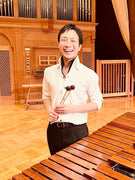
■Yuto Shimazaki / Yuto Shimazaki
marimba player, drummer, percussionist
Born on July 15, 1986. Born in Narashino City, Chiba Prefecture, lives in Nerima Ward, Tokyo.
Started playing marimba as a child and drums in middle school. Graduated from Musashino College of Music, Faculty of Music, Department of Virtuoso, and Graduate School of Virtuoso Course. He started his professional activities mainly in Tokyo while still in school, and has become a performer of all genres including various percussion, orchestra, and wind instruments.JapanPerforms in various places. Electronic marimba "malletKAT" model player.
She has studied percussion with Hiromi Isoda and Michiko Takahashi, duet with Michiko Takahashi, Sumire Yoshiwara, and Takaya Nakatani, and solfege with Kunio Sasaki.
Official website↗
YouTube channel↗

■Takeo Sasaki / Sasaki Takeo
After graduating from university, he worked at a general company, and then started working at his family's music school (KS Music).
Responsible for planning, management, video editing and live streaming of concerts and lectures.
In addition to music classes, he also shoots and edits the Yuto Shimazaki YouTube channel and other projects.
KS Music website↗
twitter↗
These are the people who are collaborating with us on our YouTube channel!
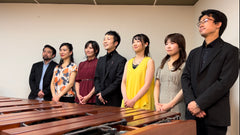
A percussion ensemble group made up of percussionists from Musashino College of Music.
With the theme of ``a percussion ensemble that brings laughter and excitement,'' the program features a percussion ensemble playing songs from a wide range of genres, from classical to jazz, rock, and vocaloids, as well as performances by a stuffed animal ensemble and air drums.JapanParticipating in events around the country.
Yuto Shimazaki often participates in performance videos and percussion challenge projects on his YouTube channel.
The current members are Yuto Shimazaki, Yuki Shimazaki, Hinako Isoda, Yu Matsuba, Takahiko Kobayashi, Harue Tomioka, and Miki Matsuzawa.
Official website↗