PRODUCTS
開発担当者が語る「鉄と向き合った5年超! K.M.K オリジナル・トライアングル 誕生までの道のり」

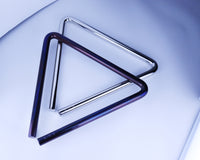
This is the first original triangle development undertaken by Komaki Tsusho Co., Ltd. Over 200 prototypes and 5 years of work.
Development that started with zero knowledge has many twists and turns.
We will report on the path to completion of the K.M.K Orchestra Triangle.
Text and photos: Komaki Trading Co., Ltd., Hiroki Uchiyama
■The impetus for development
At the request of Mr. Hidemi Kuroda, percussionist of the NHK Symphony Orchestra, we received a request saying, ``The orchestra's Triangle has the best tone, but there is a risk that the sound quality will deteriorate over time. Could you please prepare something to replace it?''
At the time, what we had available was the Studio 49 and Alain Abel products, which we had been selling constantly for over 25 years, and at the time Glover was expanding their bronze lineup.
When I asked what the ``band triangle'' was, I learned that it was made by Radik, 8 inches on each side, made of iron with a plated surface, and was made before the 1980s. As a triangle, it doesn't have any special specifications, but I think it can be said to be a ``normal triangle that makes a good sound.'' However, when I thought about it, I realized that the new triangular products that have been released by various companies over the past 10 years are almost never made of iron, but instead are made of bronze, some kind of alloy, or something that seems to have been made with some kind of twist.Although they are unique, they all claim to have rich overtones.
For example, the German Tine Triangle is famous as the ``top of bronze'' musical instrument, but in addition to its ultra-high-end price range, its very distinctive shape with each side curved inward leaves a particularly strong impression on me. When I researched how the instrument was received in the industry, I found that while it was generally highly rated, there were also surprisingly many people who felt it was difficult to use, such as ``The situations in which it can be used are very limited'' and ``That harmonic overtone is annoying.'' So, when asked what they use, it's amazing how many professional musicians answer "old Radic." Their general opinion was, ``This common sound is the most familiar to our ears, to the sounds of orchestras, and more specifically to the ears of string instrument players.''

When talking about imported musical instruments, urban legends such as, ``That sound must be made in that atmosphere, using materials that were distributed in that region at that time,'' are common in any genre, but as I've been involved in this world for many years, I've begun to wonder how true these commonplace sayings really are. I also realized that I don't even know how much I know about iron in the first place. Now, let's start the research.
■I learned that I didn't know anything about iron, in the early stages of development.
The world of iron is an abyss. It has a long history, and there are many books that explain the history of iron, but it is difficult to find books or writings on the theme of ``steel and sound.'' Occasionally there are references to this on the research sites of iron product manufacturers, but scientific research does not ultimately lead to ``evaluation of sound quality'', and in most cases this is left to musicians and enthusiasts (if anyone is familiar with such research books, please let me know (bitter smile)). So, in the end, we had no idea what to make of the prototype.
The materials for the iron triangle that many manufacturers claim are not standardized, such as "iron," "steel," or "carbon steel," but in order to make the iron material resonate, "quenching" is a must! I knew that. I also learned that iron that can be tempered = carbon steel by reading about it at the library.
In the first place, quenching is a technique for adding hardness to iron.JapanIt is said that swordsmiths developed it in ancient times to improve its sharpness, but it is completely unknown what effect it had on the tone. At first, we started with the assumption that ``physical properties that allow vibrations to be transmitted well = hardness'', and then we wondered how hard we could make carbon steel. I decided to try it. The actual production was carried out by a local factory in the same ward that was introduced to us through the ward office's Business Support Center, and they were extremely cooperative.
■Sound creation begins
At first, we focused on making it as hard as possible, and we raised the level of hardness to the point where it could be bent. However, the tone is far from that of a triangle, and the shorter the sustain, the duller the tone. Incidentally, the diameter of the round rod of Radik is approximately 12.4 mm, and domestically produced steel materials do not have specifications of such a half-hearted thickness. Therefore, from the beginning of development, we proceeded with two sizes, 12 mm and 13 mm, on both sides. This became the thickness of the final product.
By creating multiple hardness settings in 5-degree increments, we found that the hypothesis that "harder is better" was contradicted. When we showed Mr. Kuroda samples with varying degrees of hardness, he seemed to have a similar impression, saying, ``Harder iron feels like the vibrations don't reach the core of the material...'' and gave a negative review. This was an opportunity to change direction. However, "raw" ingredients that have not been baked do not produce any resonance at all. Next, we will begin the process of returning the height from quenching.

The hardness of the material before quenching became closer and closer to the hardness after quenching. Some people from the quenching factory wondered, ``What's the point of this even though there's no difference in hardness?'' However, when you compare the sounds, the difference is clear. At that point, I showed Mr. Kuroda the finished product, which was slightly harder than before quenching, and he asked, ``Can you lower the hardness one more step?'' This means that the hardness will be exactly the same as before quenching. The people at the factory were skeptical when they heard that, but they said it was still technically possible, so they decided to let them try it. What was completed was the prototype of the K.M.K Triangle that is now commercialized. Up until this point, we have accumulated over 200 samples over the past four years.


■Iron and rust

There were also various discussions regarding the surface finish. Iron is a very useful material, but it is also a material that has always struggled with oxidation and rust. Even with today's advanced technology, there are only a limited number of ways to prevent rust without damaging the sound. Plating is the best way to prevent rust, but this mutes the sound of iron to some extent. Although there is a way to ``properly prevent rust without damaging the sound'', it is difficult to realistically adopt it because it requires the use of chemicals that pose safety issues. Even as we worked on the prototype with Mr. Kuroda, we kept asking ourselves, ``Isn't there a better way?'' Some of the samples were black and dull with no surface treatment, but they still sounded better than plated ones, with more delicacy and richer high-order overtones. However, it is not a good idea to have something left unattended at a school for a long time, and when you take it out for the first time in a while, it is covered in rust. The hesitation between the two continued: ``Should I choose sound or ease of use?'' The person who gave me the opportunity was Shoichi Kubo, a timpanist who happened to be nearby at the time of the consultation. While trying out the prototype samples, we received very positive reviews and said, ``If it's for the sake of the sound, we should release something even if it's a little difficult to use.'' It was very encouraging.
■Final sample arrived at

In the final sample, based on Mr. Kuroda's suggestion, by returning the hardness to its pre-quenching level, the tone and ringing were much improved, and we have reached the point where the sound pressure is almost unaffected by plating (although there is a change in tone). We decided on a total of four types of 8-inch sizes, with two finishing methods: plating (the material is nickel, which allows for a thin coating), and baking, which creates an oxide film after polishing the surface of the material, on two types of rods with diameters of 12 mm and 13 mm.
Comment from Emi Kuroda

Hidemi Kuroda Profile
NHK Symphony Orchestra percussionist. Lecturer at Musashino College of Music. In addition to performing with orchestras, he also participates in many chamber music, musicals, and theatrical recordings.
He also serves as a judge for wind band competitions, ensemble contests, etc. I am raising three cats and two daughters.
Congratulations on completing the K.M.K triangle.
The Triangle that I currently use at my workplace is a very good one (*), and its tone has already become established as the ``tone of an orchestra.'' However, since it is a metal instrument, I wonder if the sustain will stop growing in the future and it will eventually become unusable. I was always worried about this. I spoke to a metal specialist and learned that "metal fatigue" is progressing.
Given this situation, I've always been looking for a good instrument, but I haven't been able to find anything good, so if that's the case, I wonder if it's possible to make one? That's what I thought.JapanI've always thought that Japan's steel technology is something we can be proud of around the world, so I wanted to try playing a domestically produced musical instrument. I think it was around 2017 that I approached Mr. Uchiyama.
About a year later, prototypes started arriving little by little. To be honest, the early samples gave me the impression that they were "just steel" (lol). It was a very fun experience to try out the process of gradually improving the quality of the product as they tried various things such as the tempering temperature. I was often surprised to find that just a slight change in the shape could suddenly make the sound worse, and even the coating specifications could completely change the sound.
I was very interested in the ``quenching'' process that is the key to making triangles, so I asked Mr. Uchiyama to take me on a tour (I probably would never have been able to see it if I hadn't had this opportunity). I wanted to see the situation directly at the actual manufacturing site and talk about it. I was very grateful to everyone at the factory for their warm support.
The K.M.K Triangle can basically be used in a wide range of situations, depending on the tone you have in mind. The tone changes depending on the angle and position of the strike, so it is recommended for those who are particular about playing. There are individual differences in tone, so I encourage you to try and compare as many as possible and find your favorite.
■Development with small factories and future manufacturing
As we progressed through development to this point, the processing factories that cooperated with us have been very helpful, but we also got a glimpse of the current situation where it is becoming difficult to establish a network of fragmented small factories like before. It is also true that over the past five years, there have been multiple cases in which we have been asked to do processing, only to find out that they have gone out of business. And the people working in all of our factories are elderly (and healthy).JapanI think it is a worrying situation that manufacturing is no longer going as it used to. As for this Triangle, my son (the company president), who is the same age as me, is running the company, so it will be safe for the next 20 years.
■Aiming for vintage musical instruments 100 years from now
And 20 years can be said to be the end of a product's life cycle. The other day I was interviewed about this development, and in the interview,『replace radic』That was my goal, but do I think I can achieve it? ” was asked. Regarding this, we have no choice but to wait for each individual released into the world to be evaluated in the music that will be played in the future. I believe that the evaluation of musical instruments will be formed through the accumulation of these experiences. How will the triangle that was born here be evaluated 20, 50, and 100 years from now? Imagining it is a pleasure that can only be enjoyed by those who made it. Percussionists in 2123, 100 years from now! Please let me know if you read this (lol).
It would be great if it was called Triangle's "Great Vintage".
It was released on July 6, 2022, and about five months have passed as of this writing, but thanks to everyone, it has received very good reviews from all quarters and is selling well. I am filled with gratitude to everyone involved in the development. thank you very much. And the development of the K.M.K triangle continues. We aim to further develop size variations and shapes. Please stay tuned for more!


執筆者: コマキ通商営業部・内山洋樹
取材協力:コマキ通商株式会社