PERSONS
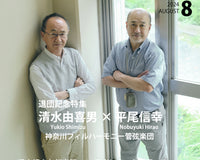
THE INTERVIEW Nobuyuki Hirao, Yukio Shimizu (Kanagawa Philharmonic Orchestra)

In the fall of 2024, two percussionists from the Kanagawa Philharmonic Orchestra will stand at a new starting line.
Ahead of this new turning point, we interviewed some episodes that you can listen to now.
Nobuyuki Hirao
Joined in September 1982, left in July 2024
Graduated from Tokyo University of the Arts. From 1987, he was invited as principal percussionist by the Korean Symphony Orchestra for one year. In 1989, he participated in the quartet section of the first Luxembourg International Percussion Competition as a member of the percussion quartet ``SHUN-KA-SHU-TOH'' and won second place.
Currently, he is active as a percussionist with the Kanagawa Philharmonic Orchestra, and in addition to performing in chamber music, wind ensembles, and solo performances, he is also active in a wide range of genres, including instructing wind ensembles, marching bands, and serving as a judge.
Yukio Shimizu
Joined in November 1985, left in August 2024
Graduated from Senzoku Gakuen College of Music and Berlin State University of Arts.
Studied under Motoichiro Shiraishi, Tomoyuki Okada, Dieter Smethny, and Klaus Kiesner.
Timpani and percussionist of the Kanagawa Philharmonic Orchestra.
Director of “Percussion Ensemble Palladium” and “Concertare Trio”
The time I was able to speak with them this time was only a moment compared to the time they have traveled together.
The words uttered in each moment contained "thoughts," "will," and "love like the soul of a craftsman."
I think it's because there's music that I've accumulated over the years that I can't really talk about, and that's why I was able to express myself in such a simple way.
There, his passion as a percussionist was ignited, and he will continue to do so in the future.
Interview cooperation: Kanagawa Philharmonic Orchestra
Photography: d’Arc Co., Ltd. Ren ARIMURA
Interview: Komaki Musical Instruments Toshiyuki Yamada Interview date: June auspicious day
◇ ◇ ◇
You are about to reach a turning point in your life as an orchestra, but how are you feeling right now?
Hirao:I joined the Kana Philharmonic in September of the year I graduated from university.
The orchestra, which had been a voluntary organization until then, became a foundation, and the time came to hire a certain number of members, and since there were no other auditions, I jumped in thinking, ``This is the only place!''
Since then, I've been living like this for a long time, so to be honest I can say that it all went by in a blink of an eye.

Shimizu:Actually, I didn't think much about this break, but I'll think about it after it's over!
There is no sense of separation.
I don't have a real sense of it yet. . .

Please tell us your memories of the Kanagawa Philharmonic.
Hirao:When I first joined the band, I thought I was just an orchestra player, but orchestra members were responsible for everything from setting the stage to distributing sheet music. It's like the first Stemane (lol). From driving a truck to transporting instruments, setting up the venue, and arranging music stands. . . I thought it might have been because the band had just been formed, but I was like, "I haven't heard of it!" I was able to do it because I was young.

Shimizu:I've ridden in the passenger seat of trucks many times.
It's hard to say what my favorite memory is, but what I remember is the encouragement I received from so many of my seniors.
In addition to music, I was involved in a wide range of activities, including activities in the baseball club (there was a baseball club at the time) and union activities.
In the percussion part, I learned a lot from Nagaso-san, Shigeta-san, Fujimoto-san, and Hirao-san, all of whom have graduated from the group. I feel like I've learned a lot since joining!

Hirao:Oh yeah! It was the first time I had ever played a song that I did.
I didn't even have an instrument, so I borrowed it from people who did.
Shimizu:I also borrowed personal instruments and taught music.
Hirao:At the time, the Kana Philharmonic was ridiculed as the "Alps Orchestra."
Even though the pay was cheap...♪Ichimanjaku. (lol)
Since we were just a fledgling orchestra, we were still technically immature, and we didn't even have a place to store our instruments, so every day was tough. Until this place (Kanagawa Art Hall) was built, we didn't have a fixed practice area, so we had to practice in a different location every day. . . . . I can't do it anymore.
Shimizu:In front of Art Hall, there was also a practice area in Sakuragicho, which was the site of a former bowling alley, and the carpeted floor was slanted and the ceiling was low, so the environment was not very good.
Hirao:It was such a gypsy life, but I forgot where it was as I went to various halls and community centers, but it was shocking to see that when the instruments were brought in, they were put in a net like the one used when unloading at the port. There's a timpani inside the net and it's being hoisted up (lol)
I'm grateful for the things we take for granted now.
Looking back, what kind of orchestra was the Kanagawa Philharmonic?
Hirao:In a sense, I guess it's "relaxing" (lol). In terms of work efficiency, I don't think our orchestra is very busy.Of course, we are still very busy, but we have an extremely demanding schedule, and we will overcome it with determination! I don't think there's any corner, or rather, there's no tingling or sharpness that can make you feel exhausted. A little bit! Just a little (lol)
Shimizu:It used to be difficult in the past, but I believe that today's Kanagawa Philharmonic is one of the orchestras that not only has a high level of individual technique, but can handle a wide range of music genres. However, we have not yet had a single overseas performance. Regarding this, I would like to see it cleared up in the future and have foil added to it.
Also, going back to what I said earlier about being "relaxed"...
When I moved here (Art Hall), there was a park next to it! There was a baseball club at the time, and we played catch at the end of rehearsals. Then, when Yuzo Toyama, the music director at the time, was leaving, he saw me and blurted out, ``It's so relaxing here,'' and from the next day onwards, I was not allowed to play catch.
It's an episode from the good old days.
Hirao:We also had fireworks (lol)

Please tell us about any unforgettable performances or songs that left an impression on you.
Hirao:An important part of the Kanagawa Philharmonic Orchestra's work is the Agency for Cultural Affairs' dispatch program, which takes them around the country. Among them, I was once dispatched to Iriomote Island. First, before the main orchestra arrives, I will conduct a workshop as the advance team and provide guidance. Koichi Ohashi (Music Advisor for the Kanagawa Philharmonic Orchestra) arranges the school song and choral music composed by the children and practices it. Now it’s time for the real thing! It was also the first time a full orchestra was sent to Iriomote Island, and people really liked it! The performance was so moving that the principal was in tears as he listened to it, the children were in tears of joy, and we, the performers, were moved and moved. I've played a lot of wonderful classical music, but the school song and chorus song that we played together was the one that left the most impression on me!
There are many good songs in this dispatch project! Lots of good memories! I'm impressed every time.

Shimizu:I was with them, and we performed on Iriomote Island. I was already impressed when I heard the orchestra for the first time, but when we played the school song and sang together at the end, I started hearing cries and sobs from some of the students...Then the teacher was moved to tears...Finally, even the orchestra members burst into tears...and some of the members couldn't play, so it was a moving concert!
After the performance, we took the bus home,
What a wonderful concert! This is unforgettable!
After I returned to Tokyo, everyone talked about this topic for a while, and my love for Okinawa deepened, and I was endlessly fascinated by Okinawa.

amazing! It was the same.
Hirao:Perhaps this is where the tradition of never cutting corners, no matter how small the performance, was born! Based on these experiences, what does it mean to have a serious attitude? Perhaps one of the good things about the Kanagawa Philharmonic is that it is able to pass on this to the younger generation.
(Continue)
Another thing that left an impression on me was Mahler's No. 6, a regular performance on March 12, 2011.
I did it for real! That atmosphere is indescribable. The customers were about half full.
Please tell us what led you to join the club, what you envisioned before joining, and what your impressions are after actually joining the club.
Shimizu:In my case, the ``Kana Philharmonic'' that I had envisioned before joining the organization did not exist. I was called up as an extra several times, and after about six months, I was told that there was an audition, and after that, I auditioned and successfully passed.
Best impression! I'm very sorry, but what I'm saying is, "Everyone drinks a lot." At that time, there was a bar area called "Noge" near the practice field in Sakuragicho, and at the end of the rehearsal, we went to Noge! Noge at the end of the performance! ! It was like that, and since there were many single people at that time and very few people who were married, it was almost every day. . . I'm not a big drinker, and at a time when such things weren't allowed, I was often addicted to alcohol. I go from one standing bar to another, and before I know it, it's morning and I'm back to square one (lol)! . This is my favorite memory from when I started.

Hirao:At that time, all the members of the orchestra were young.
I think the age of the principal class was around 40, and for several decades after that, there were hardly any auditions, so it was a time when it was difficult to get into the orchestra. I have fond memories of going out for drinks with friends and talking about all kinds of things, even though I didn't have this, I didn't have that, I didn't have any money.
In the early days, I was particularly depressed (lol).Many of the office staff didn't know anything about music, and every year when people changed, I had to start over from scratch, so I just drank!

Please tell us about what you value in performing, what was difficult as you got older, and what you focused on.
Hirao:...Because I was desperate every time (lol). Since it's my first time and I have no experience or skills, I wonder if I can do it properly, especially in the beginning. Like. However, I believe that I have been able to achieve this by accumulating one step at a time. Even now, I feel like I'm accumulating more and more each time.
Shimizu:At this age, I think age may not have much to do with my work (performance). For example, children in their 20s are doing well in their 60s! You may think so, but when it comes to music, what I do hasn't changed for a long time, so I'm desperate every time. Tyco requires a lot of preparation before performing, so don't forget to prepare so you don't get overwhelmed! Especially since I can't even afford it.
Rather, the problem is more difficult to manage my physical condition.

I think it was difficult to maintain my body as there were a lot of movements involved in the performance...
Hirao:I go to many, many, many massages, osteopathic clinics, orthopedic clinics! ! (lol)
(Continue)
Orchestras are wonderful because people from completely different generations work on the same level of work on the same soil. Isn't there no division manager or department manager like in a normal company? I think it's a good workplace to see people respecting each other. During this process, there are things that I am not good at and new things that I notice, so I think I have always been careful in that sense.

Please tell us about your future prospects.
Hirao:This will be my first freelance job at the age of 65!
I'm a little nervous about what I'll do if I don't have a job (lol), but I want to prepare and do my best to be able to handle a variety of jobs.
Shimizu:Almost the same as Mr. Hirao (lol)
I want to continue making music in this world, so I have no choice but to work hard!
Lastly, please give a message to everyone viewing JPCMAG.
Hirao:From a generation that has had fewer choices in everything, I feel that we live in an age where there is so much information out there that it becomes difficult to make choices. I think it's difficult to choose an instrument, but I want you to gather a lot of information and freely choose the instrument that suits you and enjoy it! It would be a good idea to visit JPC and ask the staff, and if you have a chance, please consult with me!
"Give me a job!"
Shimizu:I always say this at various venues, but "First, go to JPC (Komaki Musical Instruments)."
``If you go there, you'll love percussion instruments even more!'' I want people of all ages to go to Asakusa and enjoy the building as a whole. I don't think there is any other shop where you can learn things you don't know, where you can learn for free how to play this instrument, and spend hours choosing sticks and mallets. In order to keep the store open for a long time, I hope everyone will come and enjoy the store.


執筆者: コマキ楽器 山田俊幸
取材協力:神奈川フィルハーモニー管弦楽団
撮影:株式会社ダルク d’Arc 有村 蓮/REN ARIMURA
編集:JPC MAG編集部