From the percussion room of the world
From Percussion Rooms of the World Vol.12|Karlsruhe, Germany Shinichi Minami

Active all over the worldJapanThis is the 12th installment of a travelogue series in which we ask people to report on their lifestyles and local information from the local perspective, using the keyword "percussion instruments."
This time, we have received a contribution from Mr. Shinichi Minami, who is very active in Germany and is celebrating his 10th anniversary in Germany.
*This article was published in "JPC No. 164" published on April 10, 2020.
Local information
- Country: Germany
- Region: Baden-Württemberg/Karlsruhe
- JapanTime difference: 8 hours (7 hours during daylight saving time)
- Living language: German
◇ ◇ ◇
Thank you very much for giving me this opportunity.
As a Japanese citizen living in Germany, I apologize for the story from my personal perspective, but I hope you enjoy reading it. Also, as this year marks my 10th year in Germany, I would like to take this opportunity to once again express my gratitude to the teachers who have taught me and to those who have supported me.
●Why did you go to Germany?

First of all, I was intrigued by the fact that various contemporary music festivals and seminars are held in Germany, with an emphasis on modern music as well as Western traditional music, and there are many premieres of new works. Also, while enrolled in the master's program at Showa University of Music, I had the opportunity to attend a master class by Isao Nakamura, a professor at Karlsruhe University of Music. At that time, I was able to empathize with and discover my ideal music in Mr. Isao's master class, and decided to study abroad to learn contemporary music under Mr. Isao.
●Student life in Germany
To be honest, when I first moved to Germany, I was a baby who couldn't tell right from left. This is because my language skills are limited to the two months I studied in a city called Freiburg before starting my student life in Germany.
I'm in trouble. I always received help from friends who had studied abroad in Germany and people I met there. After starting my student life, I actively tried to hang out with German people and speak German. The language barrier gradually became thinner, perhaps because it was worth it. In addition, in my daily life, I actively went out into the city, reading music at my favorite cafe and taking walks. This is because everything I saw was new and I was also interested in how the people of Karlsruhe spend their time. I want to experience everything I can see and feel.
``Studying abroad is not just about practicing and taking lessons.Eat the same food as the locals and speak the language of the country.Try to absorb as much as you can.From there, you can learn about a part of the country's culture, traditions, and customs, and use that to create your own music.''
Before going to Germany, I put into practice the words that someone told me.
I enrolled at Karlsruhe University of Music for a total of four years, starting in 2010 as a soloist for two years, and then in 2012 as a first-year student in the newly established master's degree program in contemporary music. During my student years, I participated in various competitions, concerts, and music festivals. The first competition I participated in was the German Academy of Music Competition held in Lübeck, a city in northern Germany. As the name suggests, percussion majors from various music universities in Germany participate and compete. The first thing that surprised me was that each contestant had a member of staff on hand to help with transportation and setup. There is no doubt that thanks to this staff, I was able to concentrate on my performance. Another unusual incident during the final round of this competition. The player before my turn began to play from memory, but he fell silent after about 30 seconds. I vividly remember the judges laughing and saying, ``Sorry, I messed up the memorization, so let's start again from the beginning!'' and the performance restarted in a friendly atmosphere. Of course the performance was great, and I had a good laugh with him about it afterwards. He is one of the most talented and respected percussionists.
Among the many music festivals and seminars I have attended and attended, the Darmstadt Summer Contemporary Music Course was an exciting two weeks. Two weeks full of contemporary music, with rehearsals and seminars from morning until night, followed by a concert in the evening. Once again, I encountered unique composers and works, as well as wonderful performers. There are countless examples, such as works in which a music stand is scratched endlessly with a bow, and quartets using balloons and kitchen utensils.


What particularly struck me here was that a certain composer made six special rectangular prism-shaped claves for his own percussion sextet (including piano), and performed using them. It had guiro-like notches that allowed the claves to rub against each other to produce sound, and the pitch was made to change drastically depending on where they struck each other. Of course, practicing was difficult, but rehearsing with the composer present was an irreplaceable time. These two intense weeks made me reconsider the role and potential of percussion instruments in contemporary music. During my student life, I was very active and curious, and the four years passed by in the blink of an eye, but I fell in love with Germany and decided to stay in Germany and work as a freelancer.
●Germans have a craftsmanship! ?

Now, even among the percussionists I know within a narrow circle, there are many who make their own instruments. There are people who make drums like Japanese drums, people who make snare drums, people who make everything from wood blocks and all kinds of accessories to seashell chimes. The person who made it so that it can be taken apart so that you can carry a drum set on your shoulder. Or someone who recreates all the original musical instruments devised by composer Harry Partch. Moreover, all the instruments they produce are of top quality. That's one of the things that surprised me when I came to Germany. This is a little off-topic, but this is not limited to percussionists. The parents of the students I teach percussion instruments (not all of them, of course) also make their own lighting fixtures, from small lighting fixtures to large camper vans, as part of their hobby. This may be a big topic, but I understand that a company like Kolberg could be born out of this national character.
●As a freelancer
As I mentioned earlier, since graduating from Karlsruhe College of Music in 2014, I have been attending music school (JapanWhile teaching percussion instruments to children at a music school, I also work as a freelance percussionist. The music school teaches children of all ages, from 4 to 18 years old. In Germany, there are no club activities or cram schools (strictly speaking, there are similar ones, but students are free to participate), so students engage in a wide variety of activities such as learning instruments at music schools, participating in local soccer clubs, and learning karate. I started working at a music school when I was a student, so the longest time I've been teaching a student has been 8 years. Of course I'm happy to see the students' growth on their instruments, but I also find it rewarding and rewarding to play a part in adding percussion instruments to their lives.
Well, there are many different types of freelance activities. Performances at general companies and events, as well as in chamber music groups formed with soprano singers. I have also premiered new pieces as a soloist for wind ensembles and chamber orchestras. Also, the accompaniment for silent movies that I have been receiving new invitations to perform in recent years. Concerts, etc. with a choir that I have been working with for a long time. Exactly『jack of all trades』You could call it that. After 6 years of being a freelancer, I guess you could say I started to settle down.
Thanks to all the people I have met so far, the foundation we have today in Germany has been established. I will keep this in mind, and I will continue to work in Germany without forgetting my gratitude.
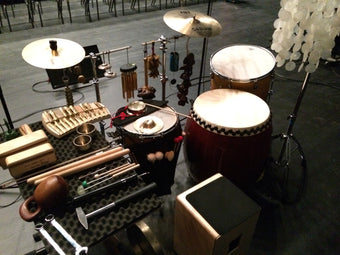
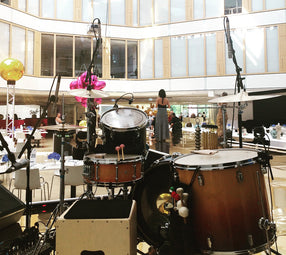
Shinichi Minami Profile
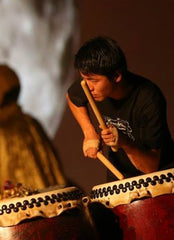
After graduating from Showa College of Music, completed the master's program at Showa College of Music.
Passed the 6th Hokuriku Newcomer Toryumon Concert Audition. Performed Marimba Concerto with Orchestra Ensemble Kanazawa conducted by Michiyoshi Inoue. After that, he continued to collaborate with Orchestra Ensemble Kanazawa in the Marimba Concerto.
Since October 2010, he has been studying at the Karlsruhe University of Music in Germany as a German Academic Exchange Service (DAAD)-funded student, and in 2012 he completed the university's state performer qualification with the highest grades. After that, he entered the university's newly established Contemporary Music and Performance Interpretation Course, and completed the course in 2014 with top grades.
In January 2011, he won first place and the Rainer Koch Memorial Special Prize at a music competition sponsored by the Baden Cultural Foundation, and was awarded a scholarship. In May of the same year, he won second place at the 59th German Music Academy Competition and performed at the award-winning concert. In August of the same year, he received the Showa College of Music Keisuke Shimoyagawa Fund. In October of the same year, he was selected from among university students enrolled in Karlsruhe.『Karlsruhe Prize』and received a scholarship from the same city.
In 2012, he was awarded a scholarship by the Karlsruhe branch of the Heinrich Hertz Society.
In 2013, he won 3rd place at the Felix Mendelssohn Bartholdi/German Music Academy Competition.
He has studied percussion and marimba with Isao Nakamura, Kazunori Meguro, Kunihiko Komori, Shoko Shintani, Hikaru Kojima, Jochen Brenner (timpani player of the Southwest German Radio Symphony Orchestra), and Thomas Hoefs (percussionist of the Stuttgart State Opera).
He has also attended master classes with Jun Sugawara, Momoko Kamiya, Peter Zadro, Svet Stoyanov, Pedro Carneiro, Christian Dierstein, Arnold Marinisen, and William Kahn.